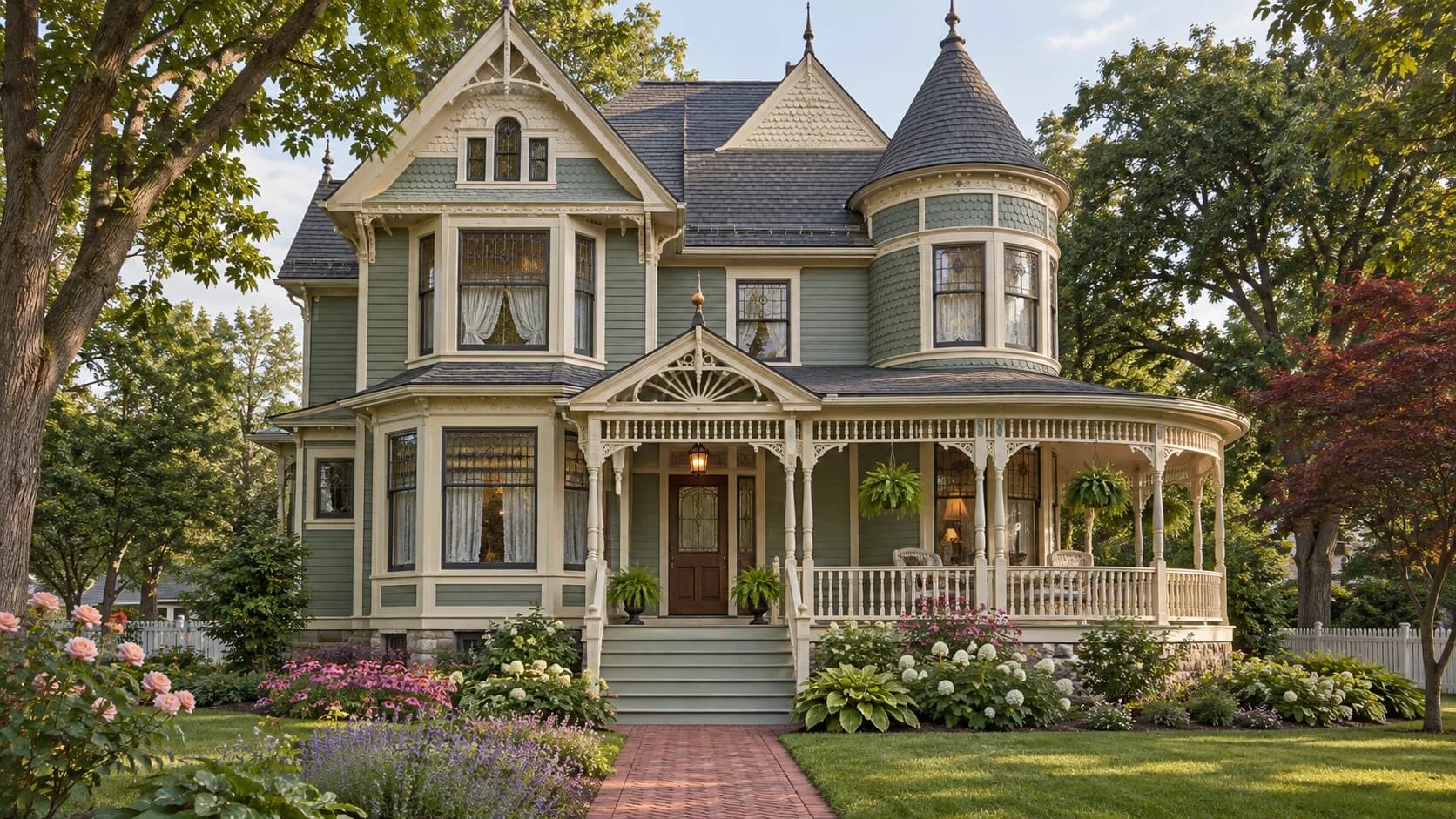
"Victorian" names a period rather than a single style. It covers buildings from the reign of Queen Victoria, from 1837 to 1901, in Britain and across the English-speaking world. During those decades architects and builders drew on many earlier styles at once, so two Victorian houses on the same street can look quite different. Recognizing the family a house belongs to is the first step in renovating it or borrowing from it.
Why So Many Styles Appeared at Once
The 19th century brought rapid industrial growth, expanding cities and a growing middle class. Factories could produce brick, cast iron, glass and machine-cut wood trim in quantity, and railways carried these materials far from where they were made. Decoration that once required a skilled carver could be ordered from a catalog.
At the same time, architects looked back to the past for models. Gothic Revival, Italianate and other revivals ran side by side, and later in the century new styles mixed elements from several sources. The result is a period known for variety and for ornament used generously.
The Main Types You Will Meet
Gothic Revival houses borrow pointed arches, steep gables and decorated bargeboards, the trim boards along the edge of a gable. Windows may have pointed heads or label moldings above them.
Italianate houses have lower-pitched roofs with wide eaves supported by brackets, tall narrow windows often topped with arched or decorated hoods, and sometimes a square tower or cupola.
Second Empire houses are recognized by the mansard roof, a steep, nearly vertical lower roof slope that creates a full top floor, often with dormer windows set into it.
Queen Anne houses, especially in North America, are usually asymmetrical, with towers or turrets, wraparound porches, bay windows, patterned shingles and turned spindlework. The painted row houses of San Francisco are a well-known example of how color was used to pick out this ornament.
In Britain, many Victorian terraced houses share a simpler set of features: bay windows on the ground floor, decorative brick or stone around openings, and patterned tile in the entrance path or hall.
What Victorian Interiors Have in Common
Across the different types, Victorian interiors tend to share a few traits. Ceilings are high on the main floor and get lower on upper floors. Rooms are separate rather than open plan, each with its own door and often its own fireplace. Walls may be divided by a chair rail and a picture rail, and ceilings may carry a plaster cornice and a central medallion above a light fitting.
Joinery is often dark-stained or grained wood: paneled doors, deep baseboards, stair balustrades with turned balusters. Colors were rich, and patterned wallpaper, carpets and tiles were common in the same room.
How to Use Victorian Ideas in a Modern Home
Start with proportions and openings before ornament. A bay window with a built-in seat, tall windows with a vertical emphasis, or a paneled front door gives a strong Victorian reference without dressing the whole house.
Inside, a few details carry the style well:
A picture rail placed high on the wall, with a darker color above or below, adds height and gives you a way to hang art without nails in the plaster.
Paneled doors and deep baseboards add shadow and depth to a plain room.
A fireplace surround, even around a modern insert, gives a room the focal point Victorian rooms were built around.
Patterned floor tile in an entrance or bathroom brings the period's love of pattern into a hard-wearing surface.
If the house is genuinely Victorian, check what survives before replacing it. Original moldings, doors and tiled floors are hard to match later. In a historic district, changes to the facade may also need approval.
Where It Goes Wrong
The common mistake is to treat Victorian as a license to add ornament everywhere. Patterned wallpaper, patterned rugs, carved furniture and a heavy chandelier in one room compete for attention. Choose one strong pattern per room and keep the surfaces around it calmer.
Mixing details from different Victorian types can also look confused. Brackets from an Italianate house, spindlework from a Queen Anne and pointed windows from Gothic Revival rarely sit well together on a small facade. Decide which family you are referencing and stay with it.
Finally, keep the modern parts honest. A contemporary kitchen in a Victorian house usually works better as a clean, well-made insertion than as a reproduction covered in applied trim.
Test the Details Before Committing
Victorian details depend on proportion: a bracket that is slightly too small or a picture rail set slightly too low changes how a room feels. Lesmee can turn your drawings into 3D renderings of the facade or interior, so the owner and design team can compare trim, color and material options before anything is ordered.