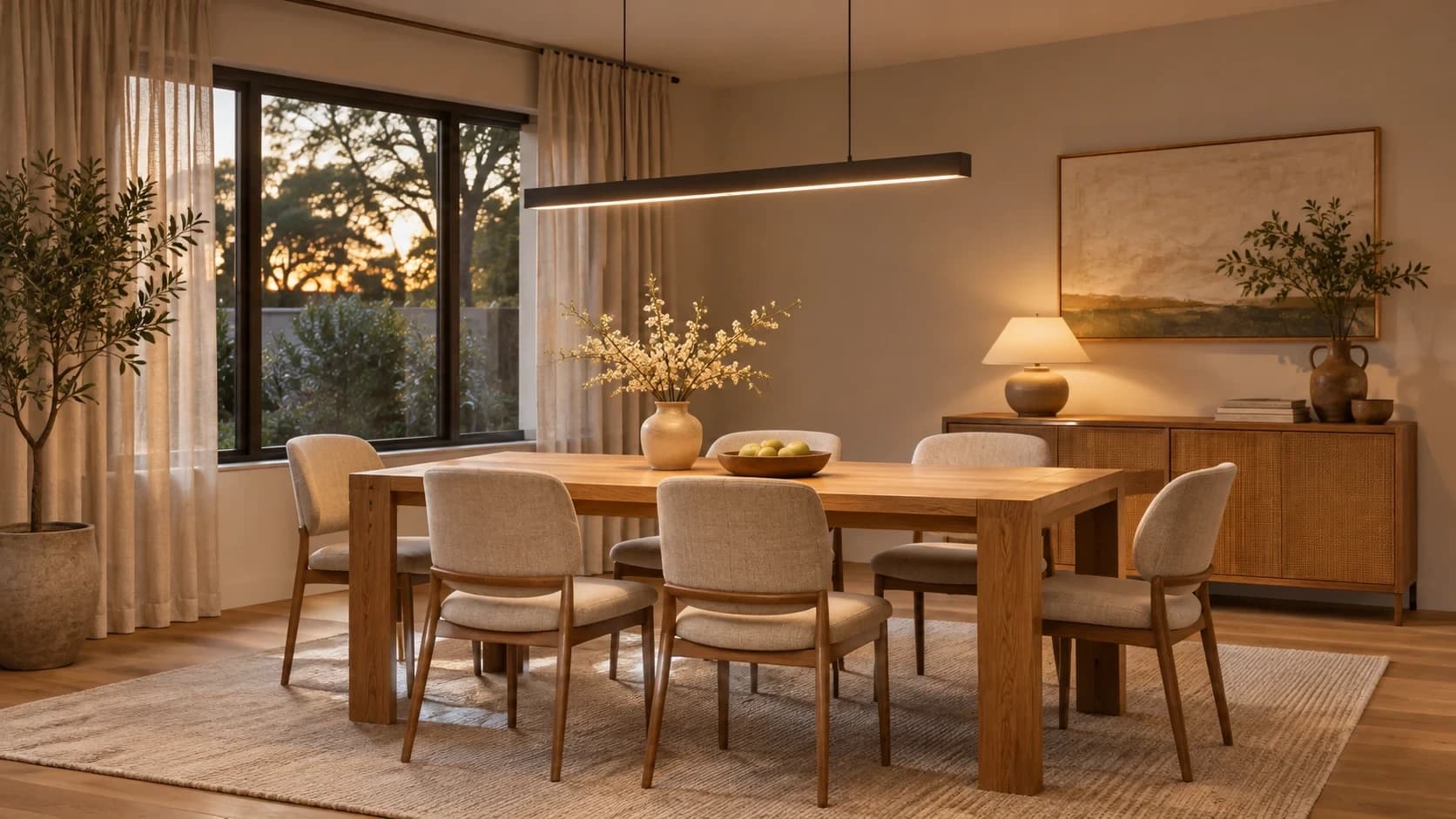
A dining room is used in a predictable way: people walk in, pull out chairs, sit for a while, pass dishes and get up again. Most mistakes come from choices that look fine in a showroom but ignore that routine. Here are the ones worth checking before you buy or build anything.
A Table That Fits the Picture, Not the Room
The table is the largest piece in the room, and its size sets everything else. Before buying, mark its outline on the floor with tape. Then pull a chair back as if to sit down and check that someone can still walk behind it, especially on the side people use to reach the kitchen.
Match the table shape to the room. A rectangular table suits a long room. A round or square table often works better in a square room or a small space, because it removes corners people bump into and lets everyone see each other. If you occasionally host more people, an extending table is often a better choice than a permanently oversized one.
A Rug That Is Too Small
A rug under a dining table must be large enough that chairs stay on it when pulled out. If the back legs catch on the rug's edge every time someone sits down, the rug will curl and wear quickly. Test it the same way as the table: pull out a chair to its sitting position and check where its legs land.
Choose a low, flat weave that chairs slide over easily and that you can clean after spills. Very busy patterns hide crumbs but can compete with the table and chairs. A plain or subtly patterned rug usually works better if the table or chairs already have strong character.
A Light at the Wrong Size or Height
A pendant over the table should relate to the table, not the room. A fitting that is too small looks lost over a long table; one that is too wide reaches past the edges and catches heads. For a long table, two or three smaller pendants in a line often light the surface more evenly than one large fitting.
Hang the light so seated people can see each other across the table without looking through or under it, and so the bulb is not visible at eye level. Check this sitting down, not standing.
Put the dining light on a dimmer, and choose warm-colored lamps. Bright, cool overhead light flattens faces and food. Add a second, softer source, such as a wall light or a lamp on a sideboard, so the room is not lit from the table alone.
Too Much Furniture
A dining room needs fewer pieces than people expect. A table, chairs and one piece of storage usually cover it. Extra cabinets, plant stands and side tables narrow the walkways and leave no space to serve.
If you need storage, a low sideboard along the wall gives a place for plates, cutlery and serving dishes, and a surface for setting food down. Check that its doors and drawers can open fully with the chairs in place.
An Oversized Centerpiece
Flowers, candles or a bowl in the middle of the table should stay low enough for people to talk across it. Sit down and check. Anything above eye level blocks conversation and must be moved before every meal, which usually means it ends up somewhere else.
Too Many Colors and Finishes
A dining room often brings together wood, stone, fabric, metal and paint at close range. Choose one main color and one or two supporting ones, and limit wood finishes to one or two that relate to each other. If the floor already has strong wood grain, a table in a similar tone may blend into it. A clearly lighter or darker table may read better.
Look at samples together under the dining light and in daylight. A finish that looks warm in the morning may look orange under evening light.
A Room That Feels Too Formal
An overly formal dining room tends to sit unused. Heavy upholstery, a large chandelier and a crowded display cabinet can make the space feel like it is reserved for special occasions. Comfortable chairs, a table surface that does not need protecting, and a light that can be dimmed for an ordinary weeknight meal make the room part of daily life.
Forgetting Acoustics
Hard floors, bare walls, glass and a stone table can make a dining room loud. A rug, curtains, upholstered seats or a fabric panel on one wall soften the sound. If the room opens to the kitchen, check how noise from appliances carries.
Check the Room Before Ordering
Table size, pendant height and finish combinations are much easier to judge in a picture than on a floor plan. Lesmee can render the dining room in 3D from your drawings, so you can compare table sizes, lighting and finishes together before ordering furniture or built-in storage.